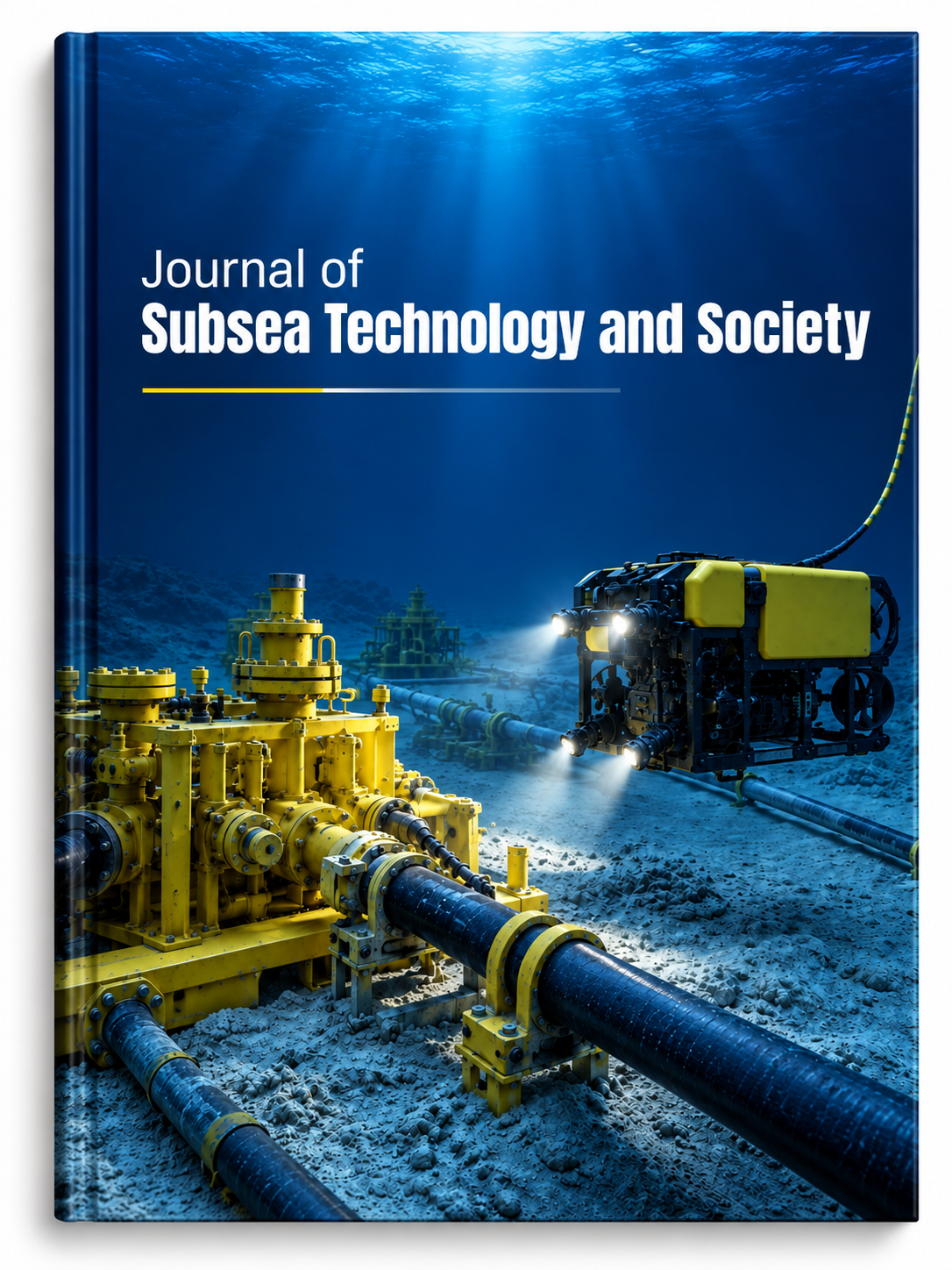
About the Journal


Journal of Subsea Technology and Society is an international scholarly journal dedicated to the advancement of subsea engineering, underwater technologies, subsea infrastructure, inspection and integrity systems, digital and autonomous technologies, and their interaction with safety, sustainability, industry, communities, and society.

The journal provides an interdisciplinary platform for researchers, engineers, technology developers, marine professionals, industry practitioners, policymakers, and scholars working on the design, operation, monitoring, maintenance, reliability, and sustainable development of subsea systems across offshore energy, marine infrastructure, underwater robotics, ocean observation, and emerging blue-economy applications.

Particular emphasis is placed on research that connects technological development with real operational challenges, including subsea reliability, structural integrity, inspection and maintenance, digitalization, autonomous intervention, environmental performance, human and organizational factors, risk governance, economic implications, and the broader societal dimensions of subsea technology.

Journal Identity
Subsea Systems  ·  Underwater Technology  ·  Integrity & Inspection  ·  Digital & Autonomous Systems  ·  Society & Sustainability
Advancing Subsea Technologies for Safe, Intelligent, and Sustainable Ocean Systems

Aim & Scopes


The Journal of Subsea Technology and Society aims to publish original research, reviews, experimental studies, computational investigations, technological developments, field applications, and interdisciplinary studies that advance the understanding, performance, safety, reliability, sustainability, and societal relevance of subsea technologies. The journal covers the following principal areas:

1. Subsea Systems and Underwater Infrastructure
Subsea production systems; subsea processing; manifolds; templates; trees; flowlines; pipelines; risers; umbilicals; subsea cables; connectors; intervention systems; underwater structures; foundations; subsea power and communication systems; offshore renewable-energy infrastructure; and engineering design of subsea installations.
2. Integrity, Reliability, Inspection and Subsea Operations
Structural integrity; asset integrity management; corrosion; erosion; fatigue; fracture; material degradation; failure analysis; reliability engineering; risk-based inspection; non-destructive testing; subsea inspection; maintenance; repair; intervention; decommissioning; remaining-life assessment; and lifecycle management of subsea assets.
3. Digital, Robotic and Autonomous Subsea Technologies
Remotely operated vehicles; autonomous underwater vehicles; underwater robotics; subsea sensors; acoustic systems; subsea communication; Internet of Things; digital twins; condition monitoring; artificial intelligence; machine learning; computer vision; predictive maintenance; autonomous inspection; underwater mapping; positioning; navigation; and intelligent subsea decision-support systems.
4. Subsea Technology, Sustainability and Society
Environmental performance of subsea systems; sustainable subsea development; marine environmental protection; blue-economy technologies; energy transition; subsea infrastructure for offshore renewables; safety culture; human and organizational factors; workforce competence; risk governance; regulation; technology acceptance; socio-economic impacts; community interaction; lifecycle sustainability; responsible innovation; and societal implications of subsea technology.
Interdisciplinary Studies: The journal welcomes interdisciplinary research involving ocean engineering, mechanical engineering, civil and structural engineering, materials science, marine technology, robotics, artificial intelligence, oceanography, environmental engineering, safety and risk engineering, energy systems, economics, management, policy, and social sciences when there is a substantive connection to subsea technology or underwater infrastructure.
Scope Note: Manuscripts focused primarily on generic offshore engineering, hydrodynamics, structural analysis, materials characterization, artificial intelligence, robotics, environmental assessment, or social science should demonstrate a clear and substantive relationship to subsea systems, underwater infrastructure, subsea operations, integrity, inspection, intervention, or the societal dimensions of subsea technology to be considered within the scope of the journal.
Journal Perspective: The journal particularly encourages research that integrates engineering innovation, operational reliability, digital intelligence, environmental responsibility, and societal considerations to support the development of safer, smarter, more reliable, and sustainable subsea systems.