Subsea Technology
Underwater Technology Innovation to Support Sustainable Development
Keywords:
Subsea Technology, Underwater Technology, Sustainable Development, Marine Energy, Marine EnvironmentAbstract
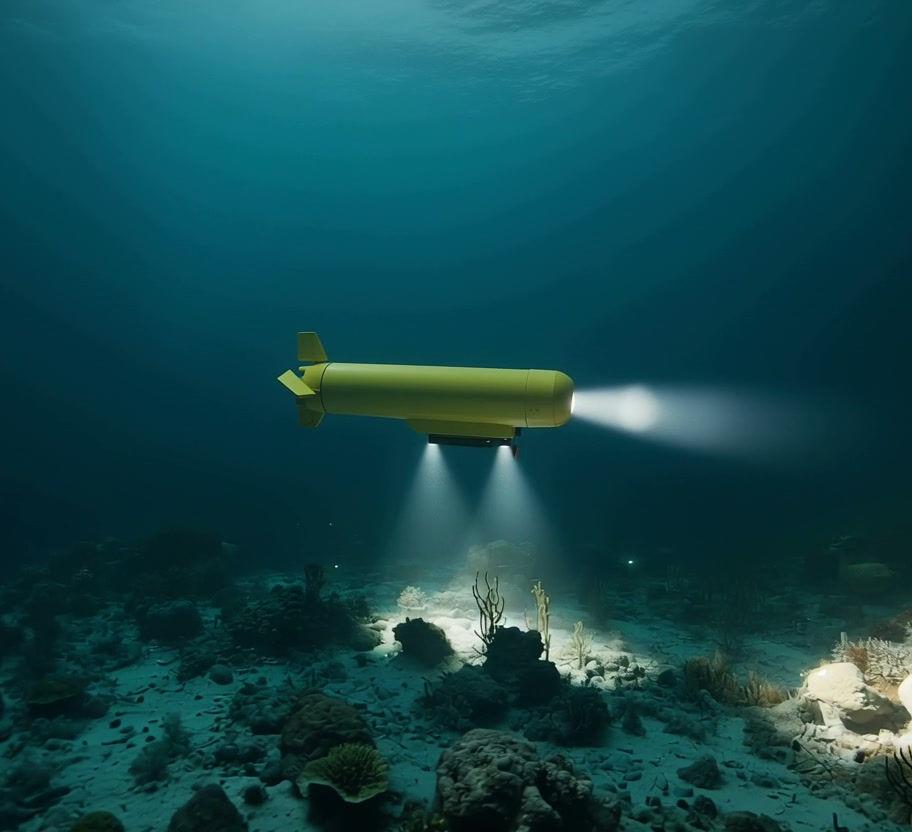
Subsea technology is one of the rapidly growing fields of technology and has an important role in supporting sustainable development, especially in the use of resources and management of the marine environment. Underwater technology includes various innovations, such as unmanned underwater vehicles (ROVs and AUVs), underwater monitoring systems, marine energy technology, and subsea infrastructure to support industrial activities and marine research. The application of this technology allows exploration, monitoring, and management activities to be carried out more efficiently, safely, and to reduce the impact on the environment. In addition, subsea technology can support the development of renewable energy, monitoring marine ecosystems, and data collection to understand environmental changes and seabed conditions. However, its application still faces various challenges, including high development costs, extreme underwater environmental conditions, limited access, and the need for human resources with special competencies. Therefore, the innovative and sustainable development and application of subsea technology is needed to increase the utilization of marine resources while maintaining ecosystem sustainability. This technology is expected to be one of the solutions in realizing balanced development between economic, social, technological, and environmental aspects.
References
[1] X. Chen, H. Kou, X.-C. Niu, C. Wang, L. Zhang, and H. Li, “Development of Deep-Sea Underwater Technology and Equipment,” Strateg. Study CAE, 2024, doi: 10.15302/j-sscae-2024.02.002.
[2] J. F. Waldner and A. Sadhu, “A Systematic Literature Review of Unmanned Underwater Vehicle-based Structural Health Monitoring Technologies,” J. Infrastruct. Intell. Resil., 2024, doi: 10.1016/j.iintel.2024.100112.
[3] D. C. Wegner, “A review on the advances in underwater inspection of subsea infrastructure: Tools, technologies, and applications,” Common. Phys. Sci., 2025, doi: 10.4314/cps.v12i5.15.
[4] M. Sandra et al., “A systematic review of state-of-the-art technologies for monitoring plastic seafloor litter,” J. Ocean Eng. Sci., 2023, doi: 10.1016/j.joes.2023.07.004.
[5] O. J. Ochulor, O. O. Sofoluwe, A. Ukato, and D. D. Jambol, “Technological innovations and optimized work methods in subsea maintenance and production,” Eng. Sci. Technol. J., 2024, doi: 10.51594/estj.v5i5.1112.
[6] A. Rohan, H. F. Tolie, M. J. Hasan, and S. Kannan, “Full autonomy in underwater robotics systems: A realistic prospect?,” Eng. Appl. Artif. Intell., Vol. 162, p. 112638, 2025, doi:10.1016/jp.2025.112638.
[7] J. Aguzzi et al., “New Technologies for Monitoring and Upscaling Marine Ecosystem Restoration in Deep-Sea Environments,” Engineering, 2024, doi: 10.1016/j.eng.2023.10.012.
[8] J. Xu, X. Irigoien, and M. Alouini, “State-of-the-Art Underwater Vehicles and Technologies Enabling Smart Ocean: Survey and Classifications,” ArXiv, vol. abs/2412.18667, 2024, doi: 10.48550/arxiv.2412.18667.
[9] M. Ho, S. El-Borgi, D. Patil, and G. Song, “Inspection and monitoring systems subsea pipelines: A review paper,” Struct. Heal. Monit., vol. 19, pp. 606–645, 2020, doi: 10.1177/1475921719837718.