Development and Application of Subsea Systems and Underwater Infrastructure for Offshore Operations
Keywords:
Subsea Systems, Underwater Infrastructure, Offshore Operations, Subsea Technology, Subsea ProductionAbstract
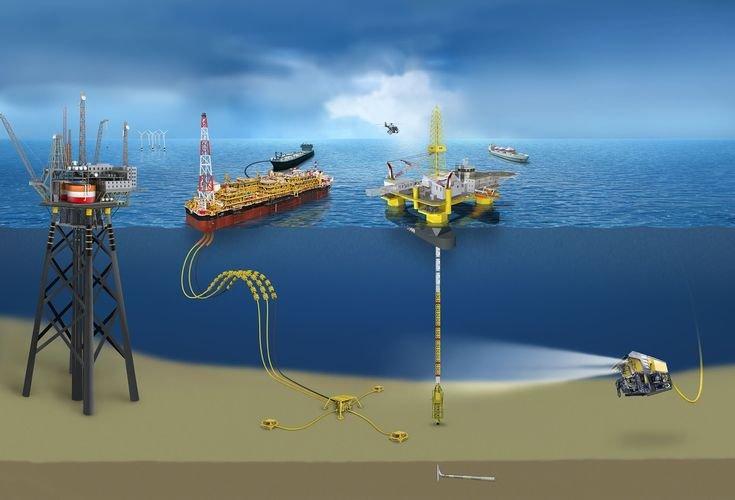
Subsea systems and underwater infrastructure play an important role in supporting offshore operations, particularly in the exploration, production, transportation, and monitoring of marine resources. The increasing development of offshore activities has encouraged the application of advanced subsea technologies to improve operational efficiency, safety, reliability, and environmental performance. Subsea infrastructure includes various components such as subsea production systems, pipelines, flowlines, risers, subsea cables, manifolds, subsea structures, and underwater monitoring systems. This study aims to examine the development and application of subsea systems and underwater infrastructure in offshore operations, including their functions, technological developments, applications, benefits, and challenges. The method used in this study is a literature review based on scientific journals, research articles, books, technical reports, and other relevant references related to subsea engineering and offshore infrastructure. The results show that technological developments in subsea systems have improved the capability of offshore operations through the use of subsea processing systems, remote monitoring, remotely operated vehicles (ROVs), autonomous underwater vehicles (AUVs), advanced materials, and digital technologies. These technologies can support efficient production, underwater inspection, maintenance, monitoring, and safer offshore operations. However, subsea systems still face challenges such as high installation and maintenance costs, high hydrostatic pressure, corrosion, complex environmental conditions, limited accessibility, and demanding reliability requirements. Therefore, the proper design, integration, monitoring, and maintenance of subsea systems and underwater infrastructure are essential for achieving safe, efficient, reliable, and sustainable offshore operations.
References
[1] R. Spanier and C. Kuenzer, “Marine Infrastructure Detection with Satellite Data - A Review,” Remote. Sens., vol. 16, p. 1675, 2024, doi: 10.3390/rs16101675.
[2] A. Ray and K. Rajashekara, “Electrification of Offshore Oil and Gas Production: Architectures and Power Conversion,” Energies, 2023, doi: 10.3390/en16155812.
[3] O. Ojuekaiye, “Industry 4.0 Remotely Operated Vehicle Management for Safer, Greener Oil and Gas Operations,” OALib, 2025, doi: 10.4236/oalib.1113398.
[4] F. Costa, “Enhancing Mooring Integrity with an Advanced ROV System for Inspection and Repair,” in Offshore Technology Conference, 2026. doi: 10.4043/36968-ms.
[5] S. Estefen et al., “Discussion of Committee V.8: Subsea Technology,” Day 1 Sun, Sept. 11, 2022, 2022, doi: 10.5957/issc-2022-discussion-v-8.
[6] C. Amaechi, A. Reda, M. Shahin, I. Sultan, S. Beddu, and I. Ja’e, “State-of-the-art review of composite marine risers for floating and fixed platforms in deep seas,” Appl. Ocean Res., 2023, doi: 10.1016/j.apor.2023.103624.
[7] O. P. Igbinenikaro, O. O. Adekoya, and E. A. Etukudoh, “A comparative review of subsea navigation technologies in offshore engineering projects,” Int. J. Front. Eng. Technol. Res., 2024, doi: 10.53294/ijfetr.2024.6.2.0031.
[8] D. C. Wegner, “A review on the advances in underwater inspection of subsea infrastructure: Tools, technologies, and applications,” Commun. Phys. Sci., 2025, doi: 10.4314/cps.v12i5.15.
[9] R. Dias, A. Dutra, A. Spinola, and A. Carvalho, “Modularization and Standardization of Subsea Components Applied to the Development of New Subsea Injection and Treatment System,” in Offshore Technology Conference, 2025. doi: 10.4043/35749-ms.
[10] R. Oluwatobiloba, T. O. Sobiyi, C. C. Egbuna, S. R. Kareem, and R. O. Lawal, “AI-driven predictive maintenance systems for loss prevention and asset protection in subsea operations,” World J. Adv. Res. Rev., 2025, doi: 10.30574/wjarr.2025.25.2.0460.
[11] C. Idiapho and G. Jamaica, “Enhancing Subsea Pipeline Reliability: A Combined FAHP and SAW Approach for Multi-criteria Decision-making,” Asian J. Adv. Res. Reports, 2024, doi: 10.9734/ajarr/2024/v18i12835.
[12] B. McCoy, P. MacInnes, D. Angelidis, R. Collins, J. Sosa, and Z. Rauf, “Optimizing Deepwater Rig Operations With Advanced Remotely Operated Vehicle Technology,” Day 2 Tue, August 17, 2021, 2021, doi: 10.4043/30970-ms.
[13] S. Rui, H. Zhang, H. Xu, X. Zha, M. Xu, and K. Shen, “Seabed structures and foundations related to deep‐sea resource development: A review based on design and research,” Deep Undergr. Sci. Eng., 2023, doi: 10.1002/dug2.12042.
[14] L. Zacchini, M. Franchi, and A. Ridolfi, “Sensor‐driven autonomous underwater inspections: A receding‐horizon RRT‐based view planning solution for AUVs,” J. F. Robot., vol. 39, pp. 499–527, 2022, doi: 10.1002/rob.22061.
[15] M. Yakubu, S. Caines, F. Khan, and S. Adumene, “Dynamic Risk Assessment Framework for Offshore Pipelines Corrosion Under Insulation,” J. Pipeline Sci. Eng., 2026, doi: 10.1016/j.jpse.2026.100457.
[16] A. Gower, “Offshore Integrity Management and Life Extension - A Vision of the Application of Subsea Robotics in Assuring Asset Integrity,” Day 3 Wed, May 03, 2023, 2023, doi: 10.4043/32198-ms.